
Subwoofer Box Carpet vs Bedliner, Vinyl and Paint: Choosing a Finish
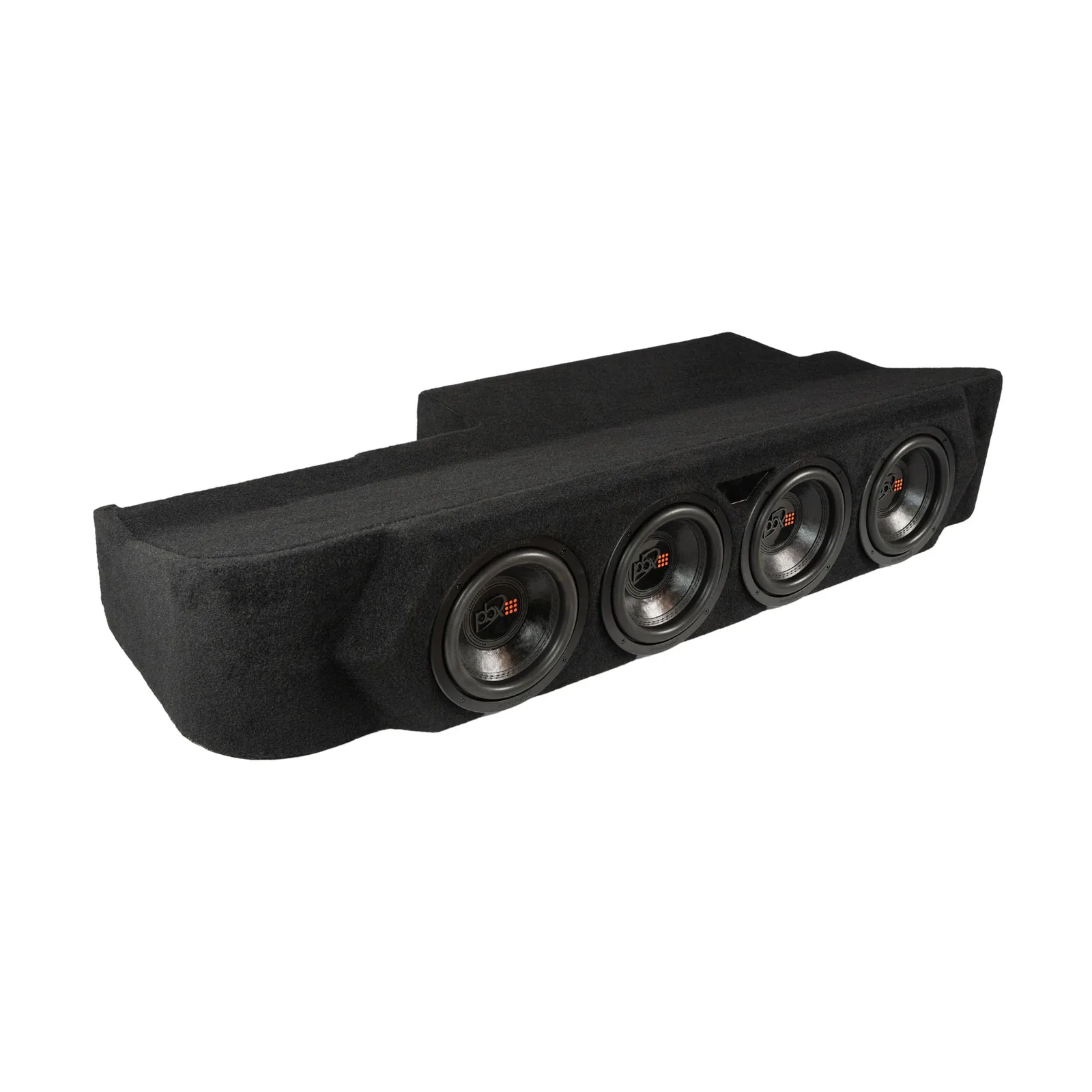
Carpet is the standard subwoofer box finish because it is cheap, forgiving and tough enough for a trunk: it hides seams and small flaws, resists scuffs, and goes on with spray adhesive in an afternoon. Bedliner is the better choice where the box will see water, dirt or cargo, like a truck bed or a work vehicle. Vinyl matches an interior and wipes clean. Paint gives a show finish but shows every flaw. None of them changes how the box sounds; the sound is set by the volume, the tuning and how rigid the cabinet is.
Key takeaways
- A finish protects the box and decides how it looks. It does not change the box's acoustics.
- Carpet is the easiest finish to apply well and the most forgiving of imperfect woodwork.
- Bedliner is the toughest finish and the best at keeping water out of MDF.
- Vinyl and paint look the best and take the most prep.
- Whatever you choose, use an adhesive or primer rated for heat. A closed car in summer gets hot enough to release ordinary glue.
Does the finish change how a subwoofer box sounds?
No, not in any way you can measure from the driver's seat. What a subwoofer box sounds like is set by its net internal volume, its alignment and tuning, and how stiff the walls are. A layer of carpet or coating on the outside does not change any of those. If you want a box to sound tighter, the fix is inside it: correct volume, internal bracing, a solid baffle, and airtight seams.
A finish can help in one small, practical way. A carpeted or coated box is less likely to buzz where it touches a trunk floor, a seat back or another panel, because the finish cushions the contact. That is a rattle fix, not an acoustic upgrade, and a strap or a rubber pad does the same job.
The four common finishes compared
| Finish | Toughness | Water resistance | Prep and skill | Best for |
|---|---|---|---|---|
| Carpet | Good | Poor | Low | Trunks, most cars and SUVs |
| Bedliner | Excellent | Very good | Medium | Truck beds, work vehicles, off-road |
| Vinyl | Good | Good | Medium to high | Matching an interior, visible installs |
| Paint | Fair | Fair, once sealed | High | Show builds, visible installs |
Carpet
Carpet is what most subwoofer boxes wear, including every Proline X enclosure, which ships wrapped in black carpet. It earns that place on practical grounds.
- It forgives the woodwork. Carpet covers seams, filler, screw heads and small gaps that paint or vinyl would show.
- It resists scuffs. Cargo, shoes and gear slide off it without leaving marks on the cabinet.
- It grips. A carpeted box is less likely to slide around a carpeted trunk floor than a bare or painted one.
- It is cheap and quick. A roll of speaker box carpet and a can of spray adhesive covers most boxes in an afternoon.
The weaknesses are water and wear. Carpet soaks up spills and holds moisture against the MDF, and MDF swells when it gets wet. The edges and corners wear first, and cheap adhesive lets the carpet lift at the seams in hot weather. For a box in a trunk, those are minor. For a box in an open truck bed, they are the reason to choose something else.
Bedliner
Bedliner coatings are the roll-on or spray-on polyurethane textures made for truck beds. On a subwoofer box they give a hard, textured, usually black shell that shrugs off impacts, scrapes and water.
- Best at keeping water out. A fully coated box, edges included, protects the MDF far better than carpet.
- Very hard wearing. It is the finish to pick if tools, cargo or muddy boots share the space with the box.
- Easy to touch up. A scuffed spot can be recoated without redoing the whole box.
The catch is prep. MDF edges soak up coatings, so seal them first, prime the whole box, then build the coating up in thin coats. Work somewhere ventilated, because these products give off strong fumes while they cure. Mask the driver cutout and terminal cup opening so they stay clean, and check the finished cutout still fits the driver.
Vinyl
Automotive or marine vinyl is the way to make a box match an interior, and it wipes clean. It is also the least forgiving finish to apply.
- Looks factory. Matched to the seats or door panels, a vinyl-wrapped box looks like part of the car.
- Easy to clean. Spills wipe off instead of soaking in.
- Harder to apply. Vinyl has to be stretched and heated around corners, and it shows any bump or seam underneath.
Round the box's edges slightly before wrapping so the vinyl does not wear through at a sharp corner, and use a high-temperature contact adhesive rated for automotive interiors.
Paint
Paint is the show finish. Done well it looks the cleanest of the four; done quickly it looks the worst, because it hides nothing.
- MDF needs sealing first. The face of MDF takes paint reasonably well, but the cut edges drink it in and raise their fibers. Seal the edges, sand, and prime the whole box before the color coat.
- Every flaw shows. Seams, screw holes and dents have to be filled and sanded flat first.
- It chips. A painted box that gets knocked around shows it. Textured speaker cabinet coatings are more durable than smooth paint and hide small flaws better.
Which finish for which install
- Car trunk. Carpet. The box is out of the weather and out of sight, and carpet protects it from cargo at the lowest cost and effort.
- SUV or hatchback cargo area. Carpet in a color close to the cargo floor, or vinyl if the box stays visible and you want it to look factory. Heavy gear lands on these boxes, so use a tougher carpet with a firm backing.
- Behind or under a truck seat. Carpet. These boxes live in a tight, dry space where the finish mostly stops rattles against the seat frame and cab wall.
- Open truck bed or work vehicle. Bedliner, with every edge and the underside coated. This is the one place where carpet's water weakness really matters.
- Show car or visible custom install. Paint, vinyl or a textured cabinet coating, depending on the look. Budget time for filling and sanding, because these finishes show the woodwork underneath.
Choosing a carpet
Speaker box carpet is made for this job: thin enough to stretch around corners, with a backing that takes spray adhesive well. General trunk liner is often heavier and stiffer, which makes clean corners harder. What to look for:
- Stretch. A carpet with some give wraps edges and corners without wrinkling or bunching.
- Backing. A non-woven backing bonds to adhesive better than an open weave, and it holds up when you pull the carpet around an edge.
- Color. Black and charcoal hide dirt and match most trunks. Gray and tan suit lighter interiors. Colors are for boxes meant to be seen.
- Quantity. Add up the area of every face, then allow extra on each edge for wrapping. Running short halfway round a box leaves a visible seam.
How much carpet do you need?
Work it out from the box's outside dimensions. Add up the area of all six faces, then allow about 2 inches extra on every edge of every face for wrapping around corners and trimming. That allowance adds more than most people expect, so do not skip it.
For example, a box 32 inches wide, 14 inches tall and 15 inches deep has 896 square inches on the front and back, 960 on the top and bottom, and 420 on the two ends: 2,276 square inches, or about 15.8 square feet. With the wrap allowance, plan on about 23 square feet. Speaker box carpet is usually sold by the yard from rolls around 48 to 60 inches wide, so check the width before you order. On a 54-inch roll a yard covers 13.5 square feet, which makes this box a 2-yard job. Buying a little extra costs less than a seam on a visible face.
Re-wrapping a worn or damaged box
Carpet that has lifted, torn or soaked up a spill can be replaced without touching the woodwork. Pull the old carpet off, scrape away loose adhesive and fibers, and let the box dry completely if it got wet. MDF that has swelled at an edge will not go back to flat. Sand it down, and if the swelling reaches the baffle or a joint, check the box is still airtight before re-wrapping. Then carpet it as below. It is also a good moment to reseal the terminal cup and check the driver's mounting screws are still tight.
Tools and materials
- Carpet. Enough for the whole box plus the wrap allowance above, from one roll so the color and nap match.
- High-temperature spray adhesive. One can covers a small box; a large single or dual box can take two. Buy the second can before you start rather than run out with one face half done.
- A sharp utility knife and spare blades. Carpet dulls a blade quickly, and a dull blade drags and frays the fibers instead of cutting them. Change blades often.
- Scissors for relief cuts at the corners.
- A staple gun with short staples for the underside and the inside of the cutouts.
- A straightedge for trimming long edges cleanly.
- Masking tape and paper to keep overspray off the driver cutout, the terminal cup opening and anything nearby.
- A stiff brush to lift the pile over seams and staples once the carpet is down.
Planning the seams
Decide where the joins go before you cut anything, because a seam is the one part of a carpeted box people notice. The usual layout is one long piece that wraps continuously around the front, top and back, with separate pieces for the two ends. That puts the only long seam on the underside or along the bottom edge at the back, where nobody looks, and leaves the face that shows in the trunk without a join. On a wedge box, run the continuous piece over the sloped face so the most visible surface has no join.
How to carpet a subwoofer box
This is how we wrap a box. It works the same way on a box you built yourself.
- Finish the woodwork first. Sand high spots and fill large gaps. Carpet hides small flaws, not steps between panels.
- Cut the carpet oversize. Measure each face and leave extra on every edge so you can wrap it around the corners and trim it clean.
- Use a high-temperature spray adhesive. Headliner-grade or high-heat contact adhesive holds in a hot trunk; general-purpose spray glue often lets go in summer. Spray both the box and the back of the carpet, and let it tack up as the can directs.
- Lay one face at a time. Start in the middle and smooth outward to push out air bubbles and wrinkles.
- Wrap the edges. Pull the carpet around each edge onto the next face, making relief cuts at the corners so they fold flat without bunching.
- Trim the openings last. Cut an X over the driver cutout and terminal cup opening, fold the flaps inside, and trim. Check the driver still seats flat and seals against the baffle, since carpet under the mounting flange can create an air leak.
- Staple the hidden edges. On the underside and inside the cutouts, a few staples keep the carpet from lifting where adhesive alone might let go.
Common carpeting mistakes
- Spraying only one surface. Contact adhesive holds properly only when both the box and the carpet backing are coated and allowed to tack before they meet.
- Pressing it down too soon. Wet adhesive soaks into the carpet and leaves dark, stiff patches. Wait until it is tacky to the touch.
- Skipping the relief cuts. Carpet pulled around a corner without a relief cut bunches into a lump that never lies flat.
- A seam on a visible face. Plan the layout first so seams land on the bottom or back.
- Covering the terminal cup screw holes or the port. Trim around the terminal cup so it still seats and seals, and wrap the carpet only over the edge of a port opening. Lining the inside of a port narrows it slightly and can trap loose fibers.
- Using a dull blade. Ragged, frayed edges are the most common sign of a rushed wrap.
Looking after a carpeted box
Vacuum the box when you vacuum the trunk; grit worked into the pile wears it faster. Spot-clean spills with an automotive upholstery cleaner and let the box dry fully before closing the trunk, so moisture does not sit against the MDF. If a corner starts to lift, re-glue it with a little contact adhesive and hold it down until it grabs rather than waiting for it to peel further. A box that rides in a damp trunk or gets wet regularly is a candidate for bedliner instead.
Frequently asked questions
Does carpeting a subwoofer box improve bass?
No. Carpet on the outside does not change the box's volume, tuning or stiffness, which is what sets the bass. It can stop the box buzzing against a trunk floor or seat, which removes a noise, not a flaw in the box itself.
What adhesive should I use for subwoofer box carpet?
A high-temperature spray adhesive, the headliner-grade kind. A closed car in summer gets hot enough to soften ordinary spray glue, which is why cheap wraps lift at the edges.
Can you put bedliner on an MDF subwoofer box?
Yes, and it is the best finish for a box that lives in a truck bed or around water. Seal the MDF edges and prime the box first, then build the coating up in thin coats.
How much carpet do I need for a subwoofer box?
Add up the area of all six faces and allow about 2 inches extra on every edge. A typical single or dual 12-inch box needs roughly 2 yards from a 54-inch roll.
Should the carpet go under the driver's mounting flange?
Only if the driver still seats flat and seals. Wrapping the carpet into the cutout is normal, but a thick layer under the flange can leave a gap that leaks air. If in doubt, trim it back so the flange seats on the baffle.
Is carpet or vinyl better for a subwoofer box?
Carpet is more forgiving and easier to apply; vinyl looks more finished and cleans easier. For a box hidden in a trunk, carpet is the practical choice. For a visible install matched to the interior, vinyl is worth the extra work.
Related Proline X models
If you would rather skip the finishing work, every Proline X enclosure ships wrapped in black carpet, CNC cut from 3/4" Langboard Elite MDF and pre-wired to the terminal cup. See the full Performance Series lineup, all Proline X subwoofer boxes, or custom subwoofer boxes built around your sub. Proline X enclosures are sold factory-direct through Audio Intensity. Building your own? Start with how to build a subwoofer box.